The Reluctant Taoiseach by David McCullagh
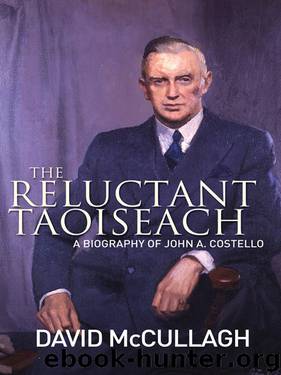
Author:David McCullagh [McCullagh, David]
Language: eng
Format: epub
Tags: -
Publisher: Gill & Macmillan
Published: 2011-12-09T23:00:00+00:00
Chapter 10
TRUMPET-TONGUED DENUNCIATION
“The country will now have a chance of seeing whether the present crowd can do any better.”1
JOHN A. COSTELLO, JULY 1951
“If that bloody fellow had been working for me, I’d have won me bloody case!”2
PATRICK KAVANAGH
In June 1953, Jack Costello characterised a series of by-election results as a “trumpet-tongued denunciation” by the voters of the Fianna Fáil administration.3 The phrase could equally serve as a description of his political approach as leader of the Opposition. During the three years he was out of power, he kept up a constant and comprehensive critique of Government policy, and in particular the austerity introduced by his constituency rival Seán MacEntee in the 1952 Budget.
But while politics played a huge part in Costello’s life in these years, so too did the law, in what was arguably his greatest period as a barrister. The aura of having headed a government added to his legendary status in the Law Library, and he was regarded as being at the height of his powers.4 This was demonstrated in the Patrick Kavanagh libel trial, discussed below.
He very quickly returned to the routine of spending most days working in the Law Library until five o’clock or after.5 But political work took up more time than it had before 1948, mainly because Costello was the recognised leader of the Opposition in the Dáil. While Richard Mulcahy remained leader of Fine Gael, Costello “would certainly have been seen in the country as the ‘real’ leader”.6 This had political implications. Costello’s pre-eminence was an indication that the inter-party arrangement remained in place, waiting for a chance to return to government. This may explain, as Cornelius O’Leary suggested, why de Valera did not attempt to solidify his position with a snap election, as he had in 1933, 1938 and 1944. This time was different, because “a viable alternative government was in the offing”.7
It is significant, too, that it was Costello, rather than Mulcahy, who approached Dillon in May 1952 with a suggestion that he should rejoin Fine Gael.8 Dillon took up the suggestion, bringing Oliver J. Flanagan into the party as well. Costello acted as a focus, organising meetings of “the Heads of the various groups which form the combined Opposition”,9 ensuring that the unity forged around the Cabinet table was not lost while on the Opposition benches. He told his constituency executive that Fine Gael would continue the work it did in the Inter-party Government “in an Inter-party Opposition”. He said the Opposition’s role was “to protect the people against the preponderant power of a mammoth party which by its very nature threatens the liberty and integrity of the citizens in a small country.”10 Observers recognised his strong position within Fine Gael “by virtue of the ascendancy he acquired as head of the former Government and of his role as formulator of policy since becoming leader of the Opposition”.11
One of the key tasks facing Costello was to defend the record of the Inter-party Government. As his close friend Senator James Douglas
Download
The Reluctant Taoiseach by David McCullagh.epub
The Reluctant Taoiseach by David McCullagh.epub
This site does not store any files on its server. We only index and link to content provided by other sites. Please contact the content providers to delete copyright contents if any and email us, we'll remove relevant links or contents immediately.
Waking Up in Heaven: A True Story of Brokenness, Heaven, and Life Again by McVea Crystal & Tresniowski Alex(37766)
Still Foolin’ ’Em by Billy Crystal(36329)
Cecilia; Or, Memoirs of an Heiress — Volume 1 by Fanny Burney(32527)
Cecilia; Or, Memoirs of an Heiress — Volume 2 by Fanny Burney(31928)
Cecilia; Or, Memoirs of an Heiress — Volume 3 by Fanny Burney(31915)
Fanny Burney by Claire Harman(26581)
Empire of the Sikhs by Patwant Singh(23057)
We're Going to Need More Wine by Gabrielle Union(19020)
Hans Sturm: A Soldier's Odyssey on the Eastern Front by Gordon Williamson(18553)
Plagued by Fire by Paul Hendrickson(17391)
Out of India by Michael Foss(16837)
All the Missing Girls by Megan Miranda(15888)
Cat's cradle by Kurt Vonnegut(15295)
Pimp by Iceberg Slim(14464)
Molly's Game by Molly Bloom(14119)
Bombshells: Glamour Girls of a Lifetime by Sullivan Steve(14037)
For the Love of Europe by Rick Steves(13809)
Leonardo da Vinci by Walter Isaacson(13291)
4 3 2 1: A Novel by Paul Auster(12354)
